
The SageOx chronoscope
Three bets from a lunch right after Opus 4.5 dropped. Two came true. It is time for the third.
Claude-aholics Anonymous
Claude dropped right before Thanksgiving. On December 17, Ryan and I grabbed lunch at Cactus in Kirkland with Steve Yegge, who had already launched Beads and was in the process of launching Gas Town.
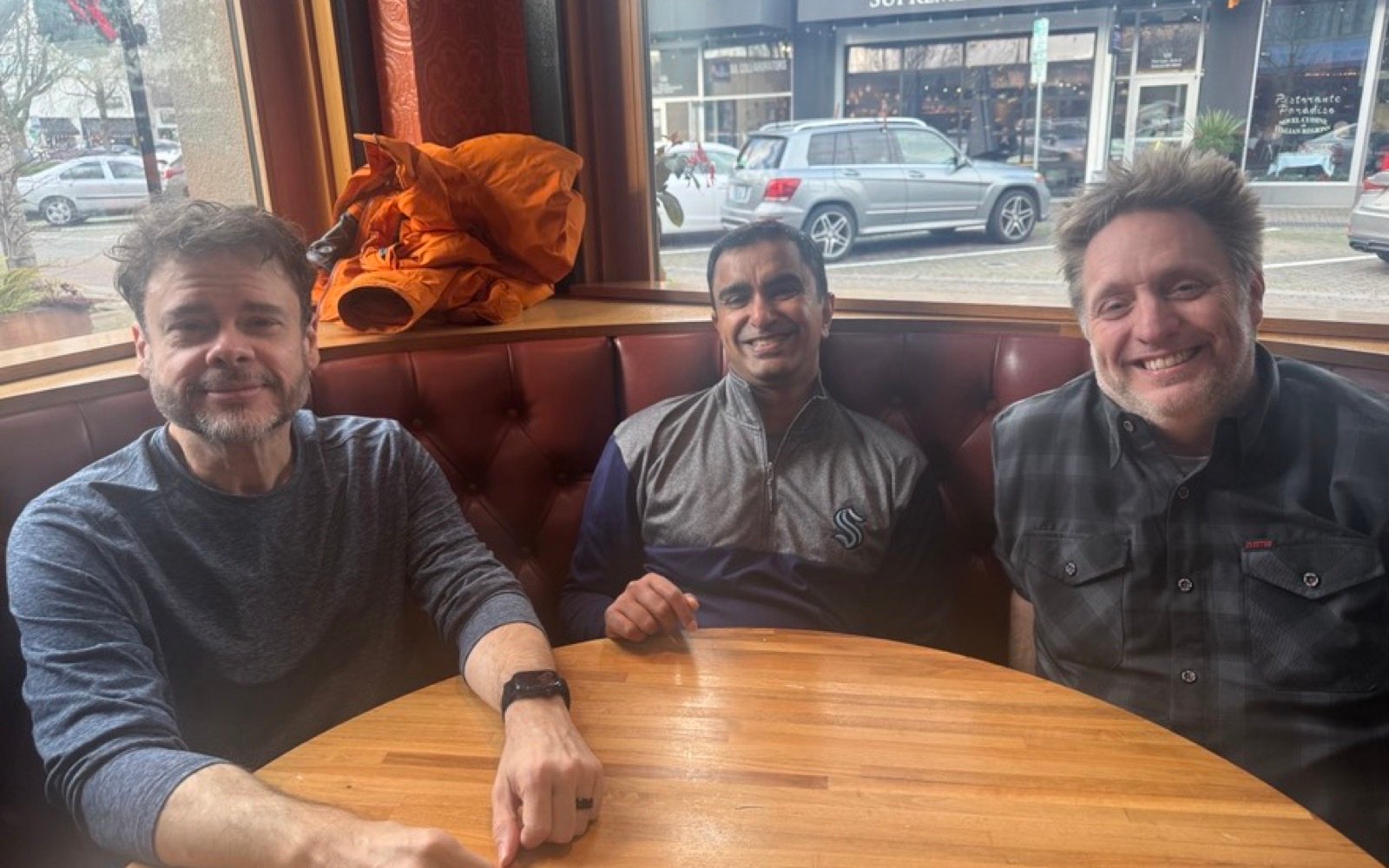
By the end of lunch, we knew we were living through a tsunami. Most of what we three knew about software engineering was going to be reinvented in 2026.
That night I posted on LinkedIn that it was the first meeting of Claude-aholics Anonymous. Three engineers living their days and nights in claude --dangerously-skip-permissions. No sleep. What Steve would later call 'AI Vampires'.
A month later the Wall Street Journal called people like us Claude-pilled.
Nine months after that, DHH got on stage at Rails World and said writing code by hand is no longer an economically productive thing to do. For most programmers. At most companies. So now the world knows that the 100x dev is real.
What we saw clearly in December 2025: what breaks when one person can do 100x? Teams.
We made three contrarian bets:
- Multiple humans. Not solo unicorns.
- Multiple models. Not just Anthropic and Claude.
- Audio and video. Not just walls of text.
Bet one: multiple humans ✅
An obvious overreach: the 100x dev means you don't need a team. One founder, a swarm of agents, the solo unicorn.
One person and their agents can build a business. But everybody else has agents too. The moment it works, it's never been easier to clone it.
Our bet is on tiny, mighty teams. Maybe even as small as two or three humans. Different instincts, more creativity, enough stamina to take turns being exhausted. People who challenge each other's bad ideas before the market does.
And those people aren't all going to live in a terminal.
Very early at SageOx, we watched how hard it was to get Milkana (product) and Emory (design) into the CLI-based tools Ryan and I used.
SageOx meets users where they are. We don't get to pick their tools.
By mid-2026, many organizations had embraced the 100x dev and were getting ready to internalize the next bottleneck: the 100x dev ships within a team. That is when Buzz showed up and let AI coworkers and humans collaborate, just like in Slack.
Multiplayer AI suddenly was everywhere.
Bet two: multiple models ✅
For a few months, December to roughly March, many believed Anthropic was the next Microsoft. Claude had won. End of story.
I spent time at Hugging Face after the XetHub acquisition. I wasn't betting against open source models. Or OpenAI.
The best model for the job changes. Your team's tools should be able to change with it. We run Claude and Codex side by side, on the same skills. When one gets better, we get better.
Our bet: your team has and will continue to have many models, harnesses and vendors.
Bet three: beyond text ⏳
This is the one that's still open.
So far the whole conversation between humans and AI coworkers is text. Walls and walls and walls of text. Plans. Summaries. Diffs. Summaries of summaries.
By the time Steve wrote the AI vampire post, we were already dying: walls of text are the express lane straight into the vampire.
Our executive function has to keep up with how fast we're now making decisions. And the AI coworkers can write faster than we can make sense of what they're saying. The bottleneck is comprehension.
AI shouldn't just compress information. It should present it in a form that people can reason with. Human visual and auditory systems are extraordinary. We catch a hesitation, read a glance, sense the tension in a room. Text strips all that away. This needs to change ASAP.
The warnings nobody hears
Every person in tech is dead tired.
Cat Hicks's book on the psychology of software teams has the reminder we keep forgetting: software is made by people. If you ship and ship and ship, there is no way your attention lands on every memo scrolling past your terminal in a wall of text.
We see it every morning at SageOx. I made a bingo card out of our own standups. We can barely remember what we ourselves did yesterday.
And this is happening at a time of high stakes. The cybersecurity situation is deteriorating at a bewildering pace. PHP2Shell is the tip of the iceberg: we are in a brave new world.
Expecting overwhelmed, tired engineers to act with world-class judgment on every memo is beyond human capacity.
So tech has to come help, or these critical calls will get flubbed.
What we can learn from pilots, surgeons, and soldiers
Pilots, surgeons and soldiers do high-quality work in highly variable environments. They rehearse what goes wrong. Again and again.
My favorite: Captain Sully on 60 Minutes, after landing a jet on the Hudson. His line was basically that he'd spent his whole career making small, regular deposits in a bank of experience, education and training. On that day he made a huge withdrawal. Pilots fly emergencies in the simulator that almost never happen. So when one does, they've already lived it.
Surgeons have M&M. Morbidity and Mortality. The cases that went badly get taken apart in front of peers. Their COE process.
The Army built whole fake Iraqi villages in the California desert. Hundreds of role players. Soldiers lived the deployment before the deployment.
The Danish poet Piet Hein has a tiny poem about this: err, and err, and err again, but less, and less, and less.
That's the whole method. These three professions have invested in techniques so that they can borrow experience before they need it. Their training allows them to viscerally feel the challenges and allows them to maintain quality judgment under pressure.
Put me in the hot seat with Asimov's chronoscope
Humans have not evolved for logic. We're built for stories. As social primates, it is genuinely fascinating for us to listen to the actual conversations backing up real-world decisions as if we were flies on the wall.
So here's one. One of the classic meetings in the history of capitalism. 1985. Intel is getting killed in memory chips. Andy Grove asks Gordon Moore: if the board kicked us out and brought in a new CEO, what would that person do? Gordon Moore's response: get out of memory chips. Then: why don't we walk out the door, come back in, and do it ourselves?
Now imagine you put on a headset and you drop into that room. You see the pause. You see the Ferris wheel of the Great America park out the window. You feel the tension.
Isaac Asimov had a name for this machine in 1956: a chronoscope. In "The Dead Past," a historian just wants to watch ancient Carthage. We want the same thing for our own company's past.
You've learned about the cognitive bias around "ignore sunk costs." It doesn't stick until you feel it in your gut when you are in the room with Andy Grove and Gordon Moore betting on Intel's future.
That gap, between making a call under pressure and reading about one, is why the Harvard Business School case method works.
My bet: soon you won't need a fancy MBA for this. Everybody at an AI-native startup gets these simulators for their own team.
The gap in decision quality between a world-class team and an average team is enormous. AI coding closed some of the gap between the best programmer and the average one. The future SageOx chronoscope is going to do the same thing for how teams make decisions. We get to build the foundation model for team savoir-faire.
Bet three: audio gets unlocked by Dessa
Bet three was blocked first, waiting for audio that narrates better than any of us.
Not text-to-speech reading your backlog out loud. A storyteller. One that sets the scene, knows where the tension is, leaves the pause in, and tells you where the call actually got made.
On October 23, Block dropped Dessa. A speech model trained on human conversation. It's almost unbelievable how good it is.
I'm no pro, so please be kind with the video that I created on the same day. But you can understand why I lost my shit when Dessa dropped, because the step up in quality is the difference between the phones that existed in June 2007 and the iPhone. It is clear as day.
Watch mine. Then go listen to Dessa. What a jump!
Bet three: video will be unlocked soon
What I'm even more excited about is video. My guess: the video models land around the turn of the year. Then you put on a headset and you don't hear about the decision. You walk back into the room with Intel's Grove and Moore and get to decide: memory or microprocessors.
So here are some public predictions for 2027.
- Video models get good enough to rebuild a believable meeting.
- Teams will have human-agent multimodal interactions. Before their daily standup, they get grounded by watching the ESPN highlight reels of the previous day.
- You put on a headset and drop into any moment of your own company's history, and get a real feel for how the people in the room made the call.
- Walls of text as the way agents talk to humans go the way of the fax machine.
We are living in magical times. I feel like I'm in the Arabian Nights and the djinn is literally making every wish of mine come true. The SageOx team will probably be visiting teams like Brilliant Labs in Guangdong in early 2027 to make these predictions real.