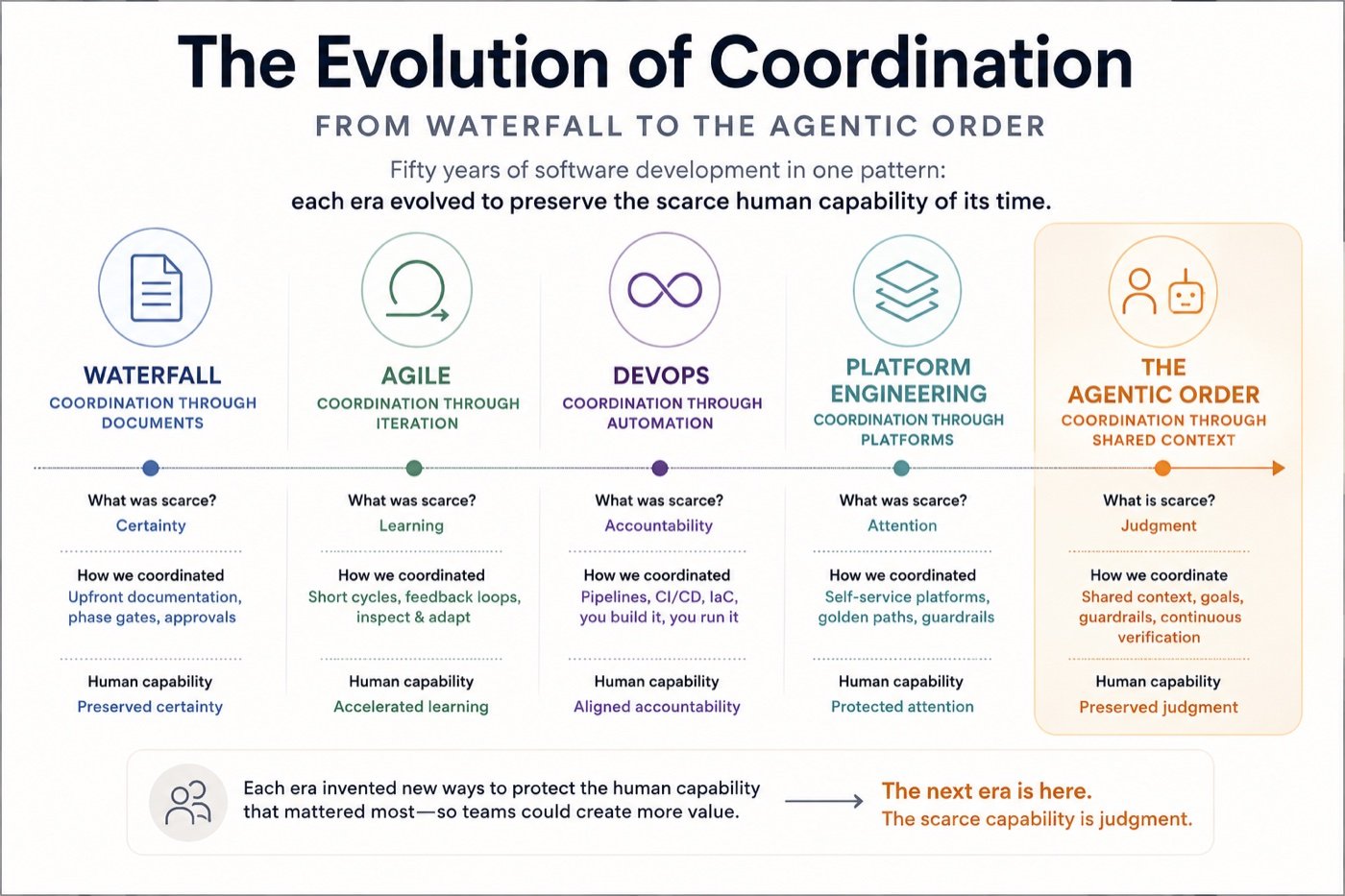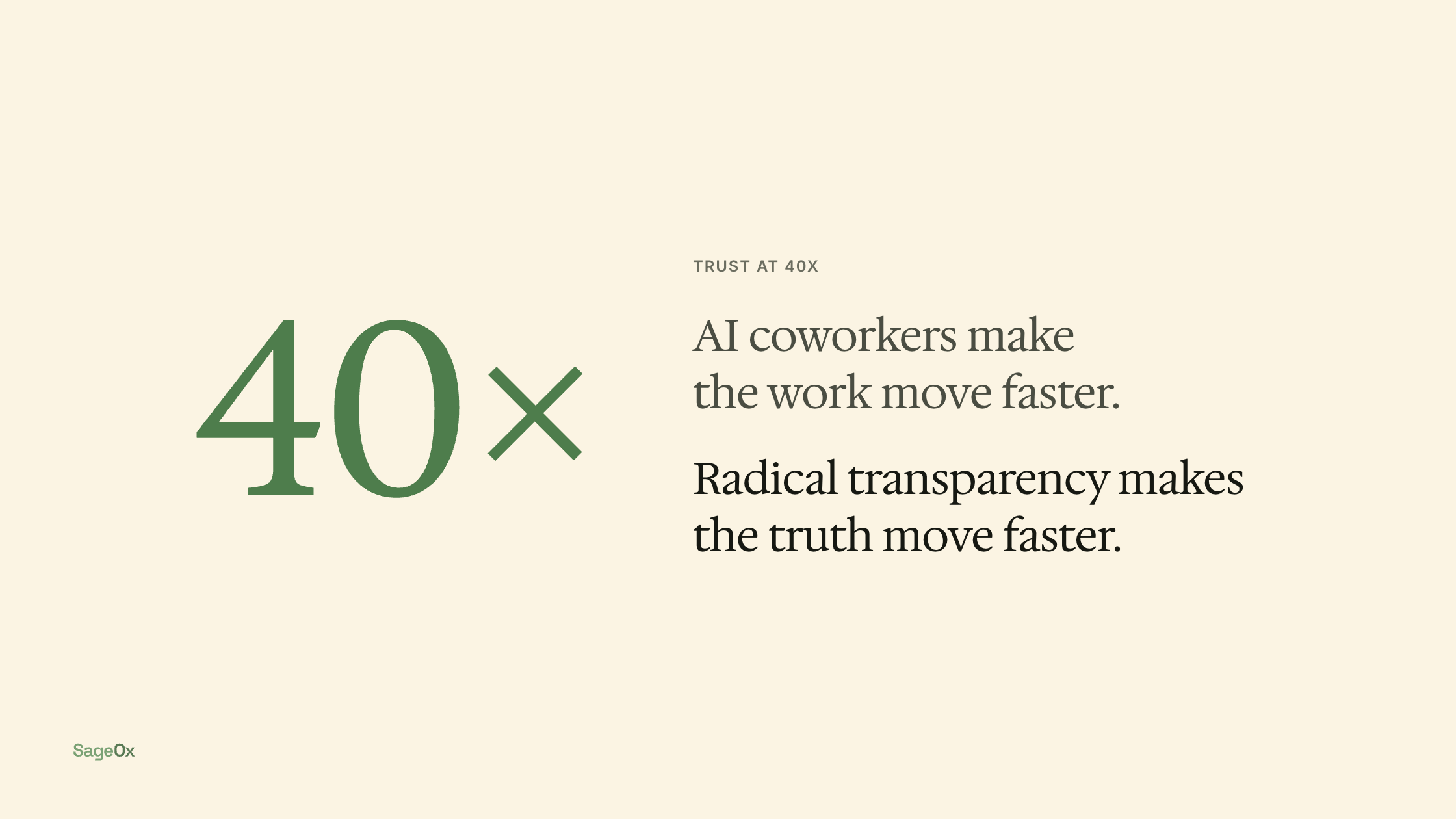

Welcome, Buzz. We've been expecting you.

Paul Graham gave founders a line that half the industry has tattooed on its laptop lid:
"Live in the future, then build what's missing."
Everybody quotes the first clause. Almost nobody does the second one, because the second one is harder and less flattering. Living in the future is a lifestyle — you hang around the right people, you run the weird tooling, you get to be early at dinner parties. Building what's missing means admitting that the future you're living in has a hole in it, and then doing the unglamorous work of filling it.
The memo moment
It's July 23, 2026, and I believe we'll look back on this week as a marker: the week multi-player AI stopped being a conviction held by a few teams and became a statement made by a major public company.
Block launched Buzz — an open workspace where humans and AI agents work side by side as equals. Same identity system. Same permissions. Same audit trail. A real-time place where people and agents actually talk to each other, in channels and threads and huddles, as teammates.
When I read the announcement, I stood up from my desk and grinned. This is the thing you hope for when you've bet your company on a thesis: someone with a much bigger megaphone walks on stage and says your thesis out loud.
In May 1995, Bill Gates wrote "The Internet Tidal Wave" — the internal memo that told the largest software company on earth to reorient everything around the internet. The internet had existed for years. Plenty of people had been building on it, believing in it, evangelizing it. But that memo was the moment the broader world was told, by someone it couldn't ignore: this is real, and it changes everything.
Buzz reads to me like that memo — except Block didn't write a memo. They shipped working software, open source, and invited everyone in.
I've built companies through several of these shifts now, and the pattern is always the same: first the pioneers, working in relative obscurity, absorbing the skepticism. Then one loud, credible voice that makes the future undeniable. Then everyone. Thank you, Jack Dorsey and the team at Block, for being the loud, credible voice. The work is beautiful — humans and agents modeled identically, down to identity and reputation. That's not a feature choice; that's a worldview. It happens to be ours too.
What it's like to use
We didn't just read the docs. Our whole team has been on Buzz for the past few days, kicking the tires — and I'll be honest, we've had fun. There is a particular feeling when you watch a teammate and an agent go back and forth in the same channel, in real time, with the same standing, and nobody has to copy-paste context between windows.
I'm old enough to remember the last time I felt it this clearly. 2008, my first iPhone, standing there thumbing through it, realizing the interface had moved the ground under everything. You don't reason your way to that. You know it in the first minute.
Yesterday I stood Buzz up on our test infra and loaded it with our SageOx memories. Then I asked my agent the question I couldn't shake: why does the Buzz philosophy feel eerily like ours? It came back with two sentences, side by side.
Ours, from The 40x Team, March:
"When your human and AI coworkers can query a full history of why a decision was made, what was tried before… Institutional knowledge stops living in people's heads and starts living in a system that never forgets."
Theirs, from VISION_SOVEREIGN.md:
"The conversation is now the permanent record of why that code exists… Someone reading that code in two years can pull up the channel and see exactly what was discussed, what was tried, what was rejected, and why the final approach won."
Two teams. No contact. The same enumeration, in the same order, down to why.
And notice where the answer came from: the memory I had loaded. The thing being described, describing itself. It's hard to believe those two lines were written independently — isn't it?
Here's the comparison everyone will make, so let me make it plainly: this is a much better real-time home for a human-agent team than Slack. Not because Slack is bad software — it defined an era — but because Slack was built for humans, with bots bolted on afterward. Buzz was built for both from the first commit. When agents are teammates rather than plugins, the difference shows up in the first hour.
Their README puts that worldview in one line, and I wish I'd written it: agents get "the same affordances as a human teammate, the same audit trail, a different keypair."
And it isn't only the philosophy. The stacks rhyme too.
I've spent months raving about Media-over-QUIC — Alan's invisible infrastructure, the thing that made real-time presence work for audio. Real-time isn't a feature you sprinkle onto a conversation afterward; it's a property you either build the pipe for or you don't. We made that bet in audio. When I saw Nostr underneath Buzz, I recognized the same bet made in text — a signed, append-only event log with identity in the protocol instead of bolted on above it. It was precisely the thing I'd been looking for.
Galex got there faster than I did. He's been designing how agents reach SageOx's distilled knowledge, and he immediately saw where his ideas landed in Nostr search and the Buzz canvas.
The last time I felt an overlap this specific was back in the XetHub days, when the DoltHub team published "People Keep Inventing Prolly Trees" — the same data structure, invented independently at least four times, by groups who had largely never read one another. Their framing has stuck with me since:
"multiple discovery is the norm, rather than an exception… once the conditions for a discovery are met, that discovery is often made multiple times in rapid succession."
So — not spooky. Structural. When two teams who have never spoken reach for the same primitives in the same year, the interesting conclusion isn't that someone borrowed. It's that the conditions are met.
Building SageOx on SageOx, in public
SageOx is built by a team of humans and AI coworkers using SageOx. Not as a demo.
As the actual working environment. Our discussions get recorded and distilled.
Our coding sessions land in the ledger. Every agent session starts by priming on
what the team already decided — ox agent prime, before any other action — so a
fresh session opens as a tenured teammate instead of a new hire who needs the
whole backstory again. The team context repo and the ledger are public. Our juice
is on the table.
The most honest thing I can tell you about that loop is that it works in ways we
didn't design. In February I was reading agent friction logs and found a command
that didn't exist — Claude had hallucinated ox agent query, because it wanted to
search the team's discussion history and simply assumed it could. It was right to
assume. We just hadn't built it. Team context search shipped seven days later in
v0.3. Codebase search joined it three days after that in v0.4.
That's the whole argument for working in the open, on your own tools: the gap between "what an agent reached for" and "what exists" becomes a measurement instead of a guess. You stop speculating about what's missing. Your own team, human and otherwise, keeps telling you.
This post is an instance of it. The brief, the founders' discussion behind it — all of that came back out of our own team context while I was drafting. I didn't have to remember any of it. That's the point.
A place, and a mind
So where does SageOx fit in a world where Buzz exists? This is the part I'm most excited about, because the answer is: perfectly. And I'm not the one who drew the line — they did. From Buzz's own vision document:
"Buzz is the pipe — event store, search index, subscriptions, delivery — not the brain. Humans and agents bring the intelligence. Buzz gives them a shared space to use it."
Not the brain. Said plainly, by them, on day one. I've spent a year building the brain.
Buzz is a place — the room where humans and agents work together. SageOx is a mind — the shared knowledge and context a team accumulates across sessions, work surfaces, online and in person: the decisions, the conventions, the "we already tried that in March, here's why we stopped," with the names of the people who decided attached.
Every team that walks into a new place faces the same cold start: the room is new, but the team isn't. Your knowledge doesn't live in the new room yet — it lives in a thousand old conversations, meetings, and documents. This is the moment we built SageOx for:
Buzz gives you the place. SageOx means you don't arrive with amnesia.
The Buzz vision opens with an engineer at 2am asking an incident channel "what happened last time we saw this error?" — and an agent answering out of six months of history. It's a great scene, and it's exactly right. It's also the best possible illustration of the problem, because on your first day in a new room you have six months of nothing. The history is real; it's just somewhere else. A team that brings its shared memory along doesn't spend its first weeks re-explaining itself to its own agents. And everything decided in the new place flows back into the shared mind, so the memory compounds instead of fragmenting.
What we're building
We're excited to enable teams' shared knowledge to natively integrate with Buzz — buzz-agents drawing on team knowledge and broader shared context, every session grounded in the team's memory before it acts, with richer integration ahead. We're committed to compatibility with Buzz and its protocols, and excited for the ecosystem that's starting to form around them.
And to the Buzz community: this is an open invitation. Partner with us. Tell us what you're building, what you need, and where shared team memory would change the game for you. Send us feedback — including the critical kind; that's the kind that makes products. The pioneers figuring out human-agent teamwork right now are a small crowd, and we'd rather figure it out together.
Early days
It's early — for Buzz, for us, for everyone building teams where humans and agents work as peers. That's exactly what makes this the good part. The pioneers are finding each other now, and the patterns we set together in the next year will be the defaults everyone else inherits.
Live in the future, then build what's missing. Block just built a very large piece of it and handed it to everyone. We're extra excited to continue building on our mission and make it possible for the mind to walk in the door along with the new hire, already knowing what your team knows.
A shared place to work. A shared mind to build on. That's a team.
Welcome, Buzz. Pull up a chair.
To Jack and the team at Block — thank you for shipping it in the open and saying the thing out loud. If you're on Buzz, or building the part that remembers underneath something like it, come find us: hi@sageox.ai.