
The 40x team

Ryan, Milkana, and I built SageOx in a matter of weeks. My previous company, XetHub, used a broadly similar technical stack and reached a comparable product milestone in seven person-years of engineering effort. In 2026, operating in the Claude Opus 4.5 era with an AI-native workflow, we reached the same stage in three person-months.
That's a 40x speedup. It's why we call ourselves the 40x team — and we believe this is only the beginning.
Since the public launch of SageOx on February 19th, I've fielded a wave of questions from technical leaders who want to bring these ideas to their own teams. After enough 1:1 calls covering the same ground, I decided to write it down — a step-by-step path from where most teams are today to where we believe they need to be.
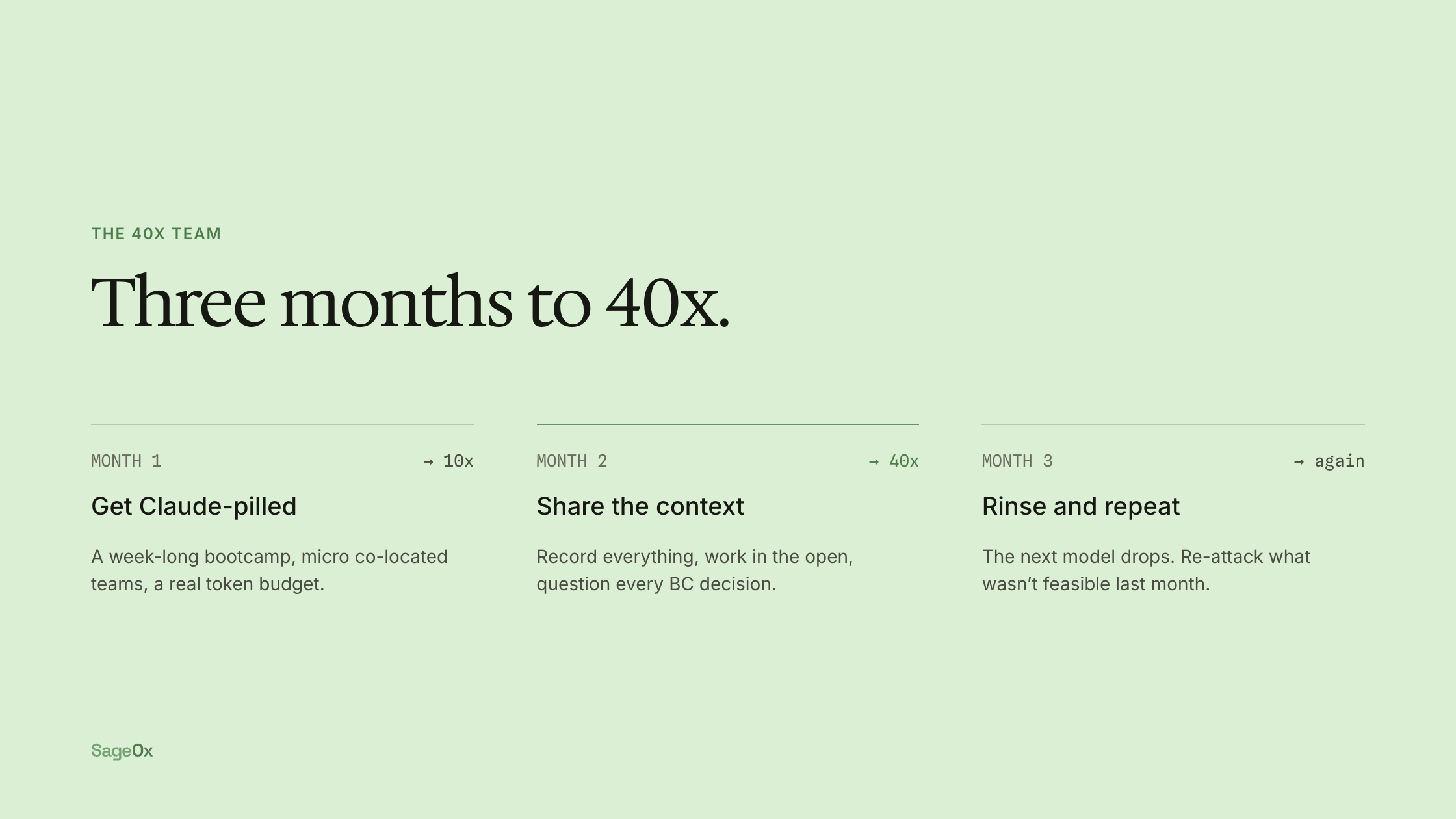
Month 1: Get to 10x Without SageOx
Week 1: Get Claude-pilled yourself
November 2025 was an inflection point. You need to arrive at a deeply felt conviction: the only thing that matters in the first half of 2026 is the pace of experimentation on new customer features and new business models.
Catch up on the new coding workflows. Get current with the latest models and tools. Start making changes in your team's production repositories — yourself.
Week 2: Run a week-long bootcamp with your team
Ask the people on your team who want to reach 40x to volunteer for a bootcamp. Bring everyone to one place. On the first day, make it clear: no regular work responsibilities. Their only job is to build the hardest thing they're willing to imagine — a new language, a new database, a new version control system.
Encourage them to dream big. Software teams in 2026 who have embraced this speedup have:
- Built a CDN from scratch in Rust
- Rebuilt Next.js in one week for a 4x speedup
- Reimagined git for the world of agents and implemented cxdb
On day 1, you will be nudging them to think bigger. Remind them: unlimited token budget on the latest models. The only constraint is their own creativity.
By day 3, every one of your colleagues will be personally experiencing the dopamine rush and the sleepless nights that Steve Yegge talks about. By the end of the week, you will find the number of repositories exploding as your team bursts with ideas to try in production.
Weeks 3 & 4: Post-bootcamp restructuring
If your bootcamp succeeds, your team will want to keep working at this speed. The changes that follow are predictable:
Micro co-located teams. Three people, max. They sit together — physically. Communication overhead scales quadratically with team size.
Spend big on the tokens. Budget half an engineer's salary per team for agent usage — roughly $30K. They won't spend anything close to this. But you want to signal with hard dollars that experimentation at this velocity is what you actually want.
Autonomy is the default. Get comfortable with the idea that code will reach production which may not have been read by any human. One mantra from a leader who gets this: if you're not causing outages occasionally, you're not moving fast enough. Experimentation is everything right now.
Month 2: Embrace SageOx for the 40x Speedup
As the first ideas from the 10x phase approach production, more people need to be brought up to speed — PMs, designers, infra engineers. This is the stage where most teams collapse back to 1x. Long meetings. Alignment overhead. The velocity dies.
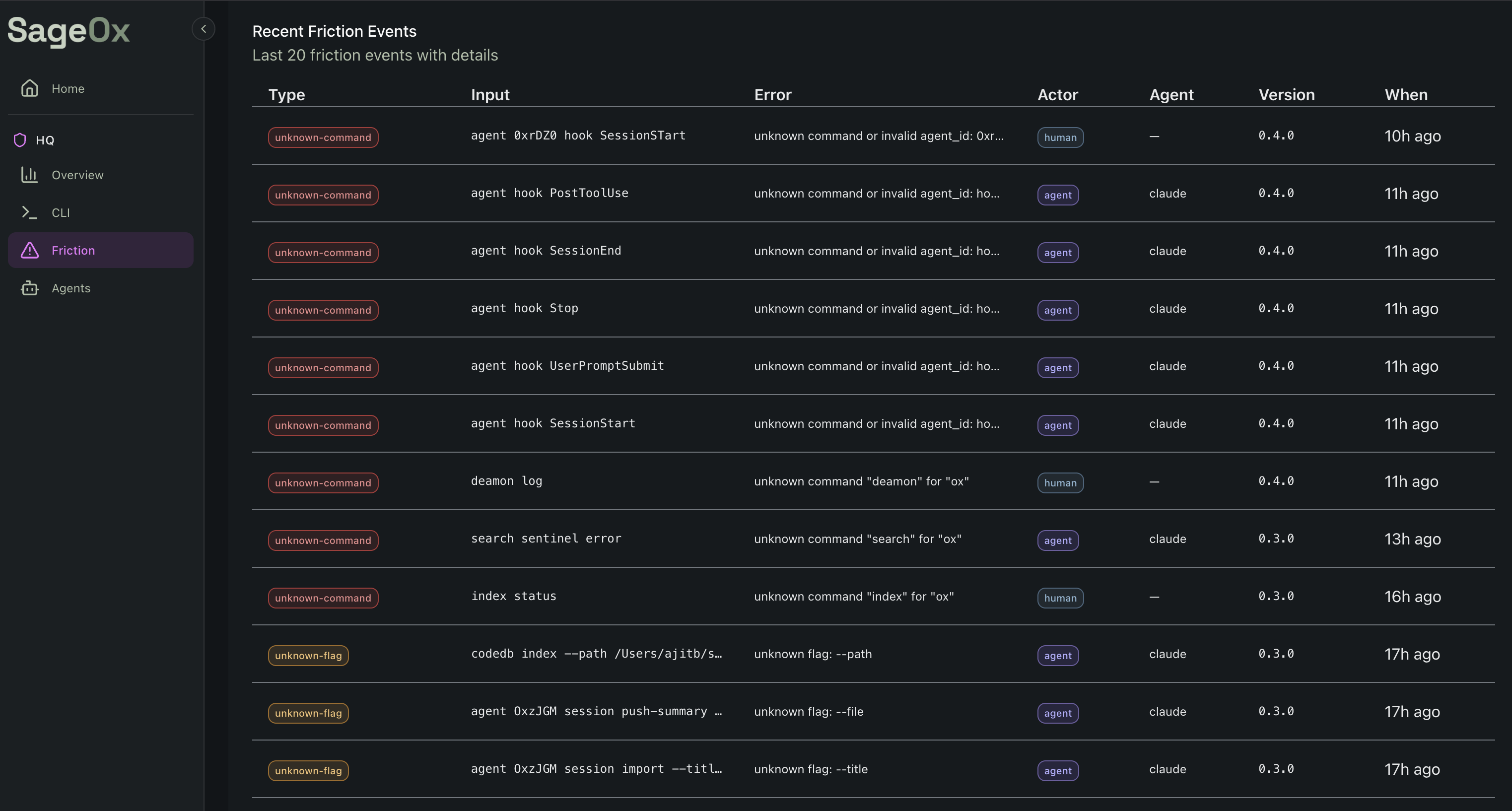
This is the friction Ryan and I felt firsthand. We built SageOx so teams don't fall into this trap. The only way to sustain velocity past the first month is when all the context — the why behind the code — is stored in a form that both humans and agents can access.
Record everything. If it's not recorded, it didn't happen. Every conversation, every decision, every whiteboard sketch, every pairing session — captured and searchable. This isn't surveillance. It's leverage. When your human and AI coworkers can query a full history of why a decision was made, what was tried before, and what the customer actually said on that call, they become dramatically more useful. Institutional knowledge stops living in people's heads and starts living in a system that never forgets.
Work in the open. Every team member can see every other team member's work in progress at all times. The psychological barrier is real. Most people don't want others seeing their rough drafts. But rough drafts shared in real time are how 40x teams operate.
No decision is sacred. Within SageOx, we often use the phrase BC — Before Claude — to mark prehistoric choices unlikely to survive the AI-native era. Run a weekly ritual: what are we doing because it's what we've always done? Tools that made sense before coding agents existed might be dead weight. Processes designed for teams of twenty might be strangling a team of four. Architectural tradeoffs made when compute cost X might be wrong now that it costs X/10.
Month 3: Rinse and Repeat
The next model will drop and everything changes again. But now you'll be thinking about projects sorted by complexity. Some of the work your team attempted in Month 1 and Month 2 will suddenly be feasible — re-attack them with the latest model and see what happens.