
The Mexican Wave
Where were you on November 24, 2025?
Think back a year. What were you doing? How were you building it? Did you notice when Opus 4.5 shipped?
Last December, right after Opus 4.5 dropped, Ryan and I were locked in an apartment, heads down with our coding agents. He looked over at my screen and said, "Dude, you're doing it wrong."
What he noticed was that I was still talking to my coding agents as if they were SDE-1s. He got me started with his Claude account, using his own payment. And after he saw me go through a few of those exercises, he commented: now you know what it is to talk to a coding agent as if it's a principal engineer. Maybe a senior principal. Maybe somebody even smarter than you.
That hurt. It's a kind of ego death for a person like me, who spent a couple of decades of his life working on his technical skills.
When we met Steve Yegge a few weeks later, on December 17, 2025, he talked about the concept of the ego death, and the five stages of grief that all of us were going through then, and that very soon the rest of the technical industry would have to go through. We called people like us at that stage Claudaholics.
And we started SageOx because of that release.
The tech industry hurtles from one release to the next, one whiplash to the next. Very rarely do we stop and focus on identifying the world-historical events that make the earth shake under our feet. I wanted to make an attempt, even though I have nothing to do with Anthropic, to acknowledge the release of Opus 4.5.
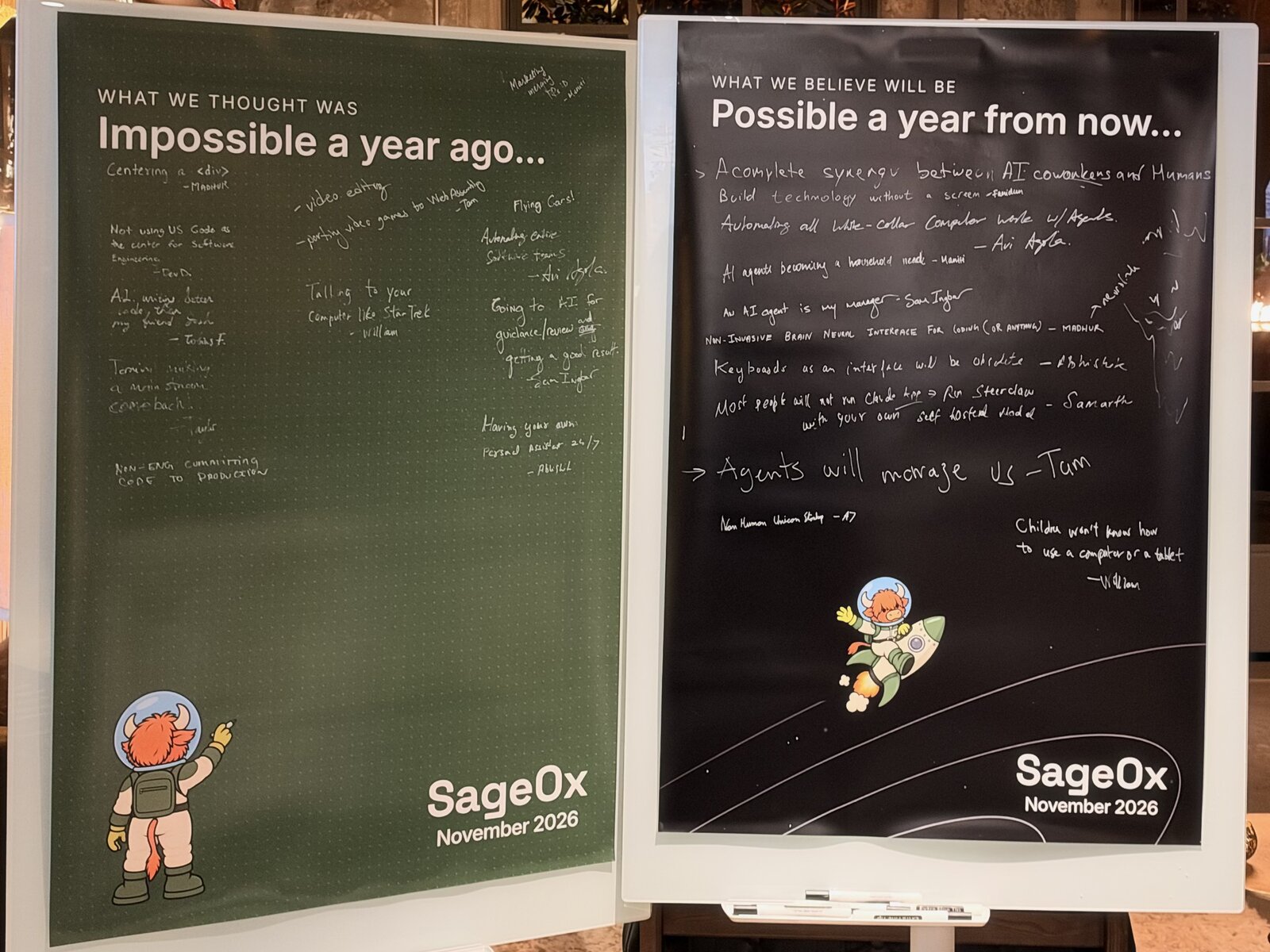
And that is why last night, November 24, 2026, we threw a birthday party for a model. Fifty people at the Labour Temple. Cocktails, dinner and a toast. We put up two boards and asked everyone to write on them what they thought was impossible a year ago, and what we believe will be possible a year from now.
The man who built the pipes
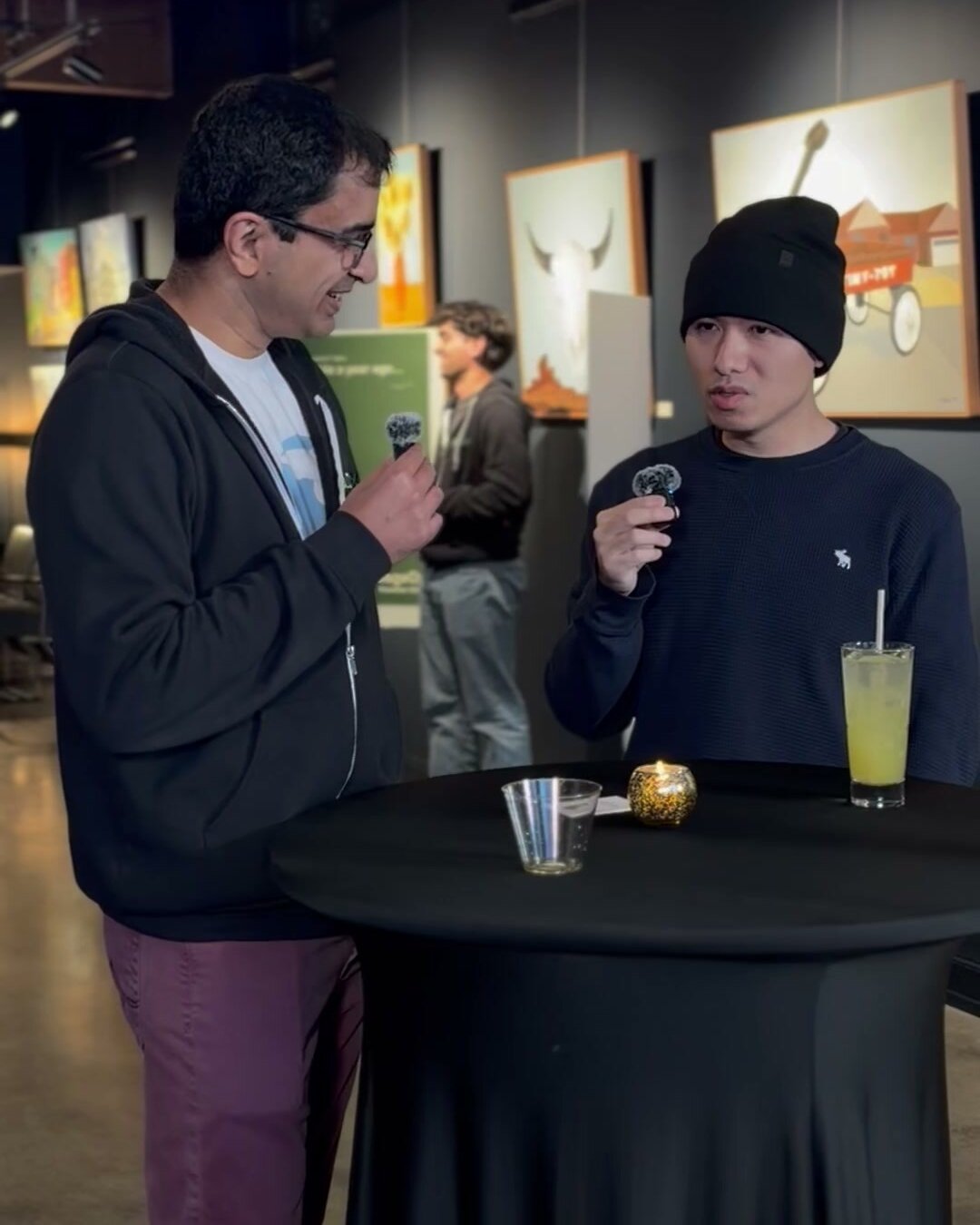
Over my career, I have been lucky to work with the folks who would go on to found companies like Temporal, DeepSync, AG2 and many, many others. But the person I was most keen to talk to in that room was Andy Peng.
Let me tell you the story about Andy.
Late in 2023, Andy joined a small team at AWS tasked with running Anthropic's models on Bedrock. He was engineer number two. For a year, the project was locked down. Even colleagues inside Amazon couldn't see the code. His team held working sessions with Anthropic engineers twice a week, chased bugs from dawn to dusk, and walked over to happy hours in SLU whenever a big release shipped. Jacob Colker tells the longer story here, and Andy wrote his own account.
My favorite detail: as late as 2024, at a big computer vision conference, Andy told people that he was working on Claude, and many of the people there had not even heard the name.
That's what standing up early looks like. Everyone else is still sitting.
I think about the Mexican wave a lot. The first people to stand up look strange. Everybody around them is still sitting, holding their drinks, wondering what's wrong with them. Then the next section stands up, then the next, then it catches, and the whole stadium is on its feet.
The funny part, though, is that the people who build the stadium are often the last ones to stand up in the wave. When November 24 hit, Andy was heads down on his own work, building in Kiro. Claude came into his hands around June 2026, and that was when he felt the feeling of talking to an agent as if it was a senior principal.
I love this story because it reminds me of my own introduction to Amazon. In January 2003, I joined Amazon, on a team called Software Platform, which is where I met Ryan, Paul Nordstrom and Maxim Fateev. Very early on, I was handed a huge project called XDQ, and I had a chance to meet with some of these principal and senior principal engineers. And Paul was in the room last night, too.
I love to celebrate the quiet, grounded infra people, the ones who make the plumbing work so everyone else can have the big moment. Seattle is full of them. When they stand up, the Mexican wave catches.
How fast trust moves here
We hear a lot of stories out of the Bay Area. What I love about Seattle is that we have an incredible amount of trust here.
I found Andy's post a few days before the party and sent him a cold invite, with a sheepish PS apologizing for the late notice. His reply came back the same day: "I'd be happy to join the celebration."
That's Seattle. Someone you've never met reads your note, and shows up.
What it feels like when a Mexican wave catches
A month ago, we took the whole SageOx team to Lisbon for a week. The first two days, we spun our wheels. Then it clicked. One person's half-formed idea became another person's prototype before lunch, and it was running by dinner. Twelve people and their AI teammates: Claude, Codex, Antigravity, the works.
That's when I saw the wave go from one engineer and Claude, to two founders in an apartment, to a whole team.
Feynman once wrote that, from a long view of history, the most significant event of the 19th century would be Maxwell's discovery of the laws of electrodynamics. I think November 24 was our Maxwell moment.
So here's what you missed. A Tuesday night, just before Thanksgiving, in the Labour Temple hall on First Avenue. The engineer who built Claude's pipes at Amazon, a few tables away from the senior distinguished engineer at Temporal who mentored me there 22 years ago. Fifty people writing their predictions on a board, and a toast to a model's birthday that only makes sense this year.
You weren't there. That's fine. We're doing it again on November 24, 2027.
Between now and then, do one thing. Go write up those predictions, about what was impossible a year ago and what we believe will be possible a year from now, and drop me a note.
PS: The wave itself is a Seattle invention. On Halloween 1981, UW cheerleader Robb Weller and Husky band director Bill Bissell got the crowd at Husky Stadium standing up section by section during a 42-31 win over Stanford (UW Magazine tells the story). Oakland fans will tell you Krazy George did it two weeks earlier. We'll let them have that one. The rest of the world calls it the Mexican wave because it went global at the 1986 World Cup in Mexico.