
Design principles for two-pizza unicorns of the A.D. era
Perfectly content people don't discover new lands
"If prozac had been available in the days of the great mariners, they would have popped a pill and stayed happily partying in Seville, Lisbon or Cádiz instead of embarking on momentous explorations. Perfectly content people do not discover new lands, do not circumvent the globe, and do not create revolutions in science. If everything is hunky-dory why bother?" — Erik Calonius, Ten Steps Ahead
Last week, we took the SageOx team to Lisbon, the city the great mariners sailed from. We spent the week in a windowless conference room on floor −1 of the hotel Locke de Santa Joana, locked in a state of flow. In five days, we merged around a thousand pull requests and added roughly 700,000 lines of code.
Much of the innovation took place in a brand-new repository, where our motivation was to imagine what would be the case if we had models that were ten times more intelligent than what they are today, in terms of their conversations, context, audio and video integration. And what that would allow teams of developers, designers, business people and product managers to build within days, maybe hours. We gave the team absolute leeway to act as if everything we had built for the last 12 months was part of the B.C. era (Before Claude), and asked them to reimagine how they would work: act as if 11/09 was day 1 for SageOx.
On the first morning I told the team two things, and I'll say the same two things at every hackathon, whether the next one is in Timbuktu, Montreal or Antarctica. A, break new ground. If it's work we have already done, I don't want to do it. I want to go to a place where we don't have maps. B, say yes. It was almost exactly a year since Milkana, Ryan and I decided to team up on this venture, and everything this team has done since started with people saying yes to ideas that were half-formed.
We had one rule for the product we envisioned: its users come as they are. Their own agents, their own weird way of thinking, their own hours. The best ideas often come from people whose brains are wired least like everybody else's, and the product has to make room for them. That rule came straight from how this team works.
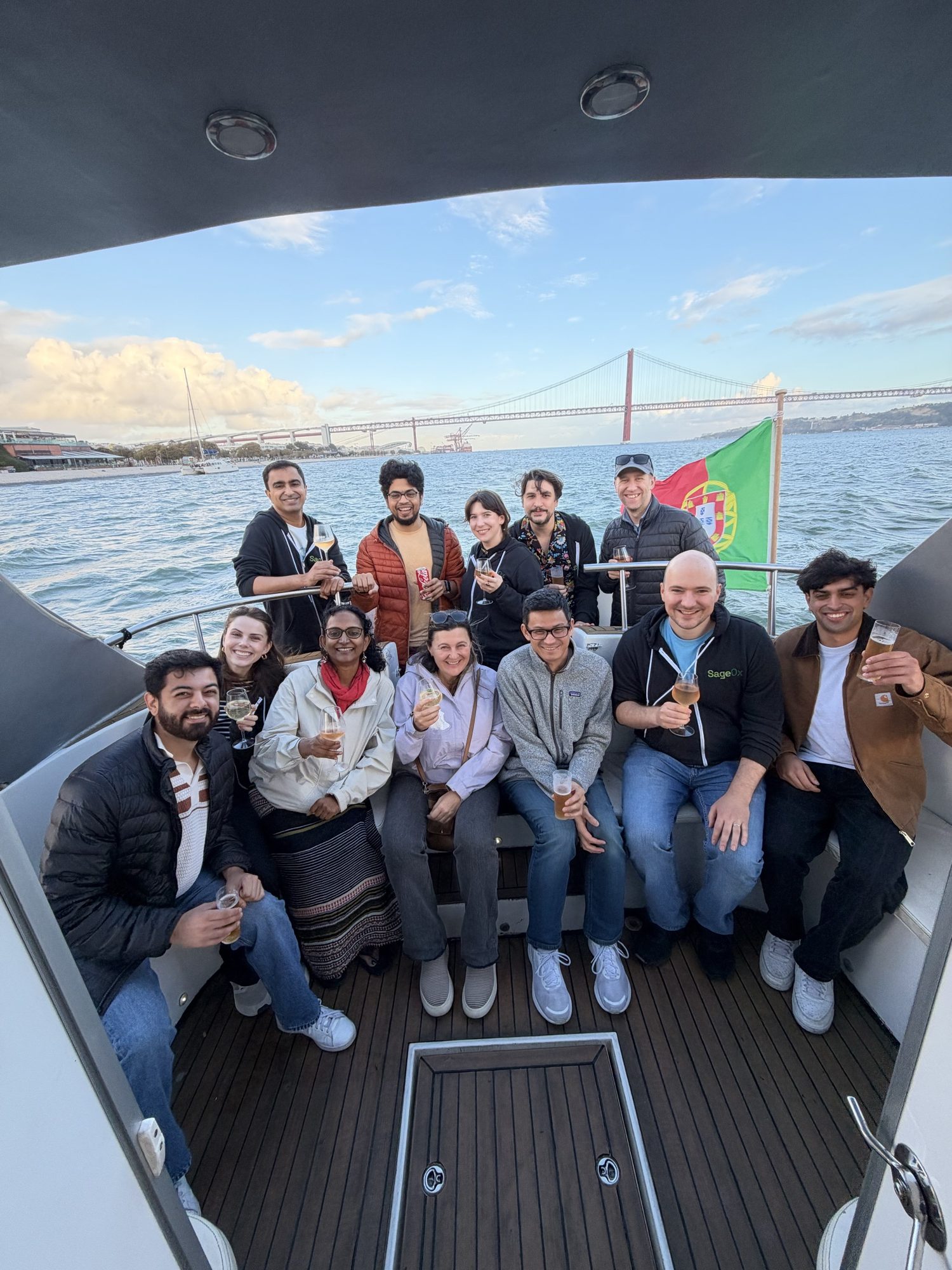 Friday evening on the Tagus.
The photo above is the team celebrating on Friday evening. You can see the exhilaration on the entire team's faces. This is a team that has worked very, very hard, and is allowing itself to look forward to the time when they are back in Seattle, enjoying the fruits of the work they did in Lisbon.
On the flight home, I tried to answer a question my teammate Lau asked while we were on the cruise: why don't more teams behave and act like this? And what I realized is that there were a bunch of very intentional acts that Ryan, Milkana and I had done when we were building this company's telos. It's time now to write those down, so that Lau and everybody else within and without SageOx has a sense of how one should design a company in the A.D. era.
Why restlessness is the design input
In January 2026, we made a bet. Co-creation of products with humans and agents would be the most volatile frontier in software for years. Tools were changing monthly, but model behavior was jumping exponentially and unevenly. What was considered mind-boggling in March was guaranteed to be embarrassingly primitive by June.
When you are trying to design a team to navigate weather like this, contentment is a liability. A team that is comfortable with how things worked last quarter is guaranteed to fall behind. So we built SageOx instead for restless people, people who love the sense of exploration that comes from creation, who thrive when they are given wicked problems, who love being in one room for long periods of time, and who can do that without killing each other. Typically founders themselves.
And honestly, people who are OK stoking small revolutions, because we are working through the biggest paradigm shift of our lives. Every company so far has run on tacitly defined focal points: who gets credit, who's allowed to have an idea, what "a day of work" looks like, what's a human job and what isn't. All companies can do with a shot of anarchy as they redefine these.
We are entering a world where what is uniquely human is being attacked at a very fundamental level. If you keep the B.C. focal points, you'll get a perfectly well-behaved team that is perfectly dormant. So the first job is to shake the unstated focal points up, on purpose, and then rebuild new ones together.
We three SageOx founders came up with these three principles.
1. Design the team design method
I've had the pleasure of being in the Bay Area during the dot-com boom, and at AWS when EC2 was created, and I've seen the kind of teams that make a product like S3 happen. Great teams usually run on ad hoc principles. This time around, we decided to be intentional, and write down the principles that matter at each layer. So here we go:
| Layer | What we do |
|---|---|
| Math | Two-pizza team, one shared physical space. Every extra person adds communication paths you pay for every hour. |
| Science | Use AI for communication and cohesion, not only code. Agents get text. Humans get visuals and audio. |
| Tech | Collect, distill, prime, in real time. Every discussion and coding session becomes Team Context the next teammate, human or AI, starts from. |
| Design | Rooms full of whiteboards, screens and plants. Information radiators everywhere, so anyone can see what's happening and jump in. |
| Psychology | Say "it's safe" again and again. Hire for adventurousness. Joyfully destroy the past. |
| Jurisprudence | Give people time to unlearn the ego reflex to grab credit. Abundant ideas come out of the team soup and belong to the team. |
| Epistemology | Be ambitious in range. Bring more disciplines into every problem. AI makes perspectives that were once too expensive to assemble cheap enough to invite. |
Our aspiration for the team was founded on openness, which would result in a very horizontal and informal communication style, which then would result in real-time iteration in very tight physical spaces. Our hope in building such a team was that people from the B.C. era who thrived on ego, fear, politics or bureaucracy would automatically self-select themselves out. And this team would be attractive to the kind of people who built the early internet. The people who want software built around rough consensus and working code.
It was very important to us that the team flow was viscerally experienced by everybody. That's one of the reasons why working together in a physically co-located space, a very beautiful one in Seattle, at AI House and the Labour Temple, was a foundational concept for the team design.
2. The addictive exhilaration of making things together
In the last year and a half, we software engineers have had a very special moment, when we realized that the ceiling is gone. With the arrival of these models, many things that we literally thought were expensive are just not expensive anymore. Once you have this insight, you realize that hunger and ambition are more important than tenure. And the kind of people you want are people who think they can build anything. In this era, the moment you allow yourself to think that, you literally can build anything.
This is how SageOx works now. We have shipped firmware for a hardware device this year, and none of us had touched hardware for more than two decades. Once you start seeing how much we can make together in a week, you start imagining worlds that you would never have let yourself sketch.
For us in Lisbon, it hit on the second day, Tuesday morning. Madhur was not able to fall asleep because of jet lag, so at 5 a.m. he unleashed his agents on our codebase. When we walked into the demo in the morning, a 3D room appeared where agents walked around, tagged each other, and started acting on real pull requests. It was clear to us that SageOx had allowed teams to drop themselves into a new era, where co-creation IDEs became something closer to a video game than the previous world of boring terminals and text. By Thursday, Ryan was saying: so far I've been telling everybody that SageOx is the next GitHub, or the next Hugging Face. Now I might have to recalibrate and call us the next TikTok.
3. The soup
One of the key insights from that week of crazy innovation in Lisbon was that it's almost as if you are putting good ingredients in a soup, and amazing things are coming out of the pot.
Putting the right people together in the right place results in a team chemistry, which is all about unlearning past behaviors. Of course, we are a capitalist company. Of course, we plan to make a lot of money with the products that we love. But the primary focus of the work we do is around giving the people in SageOx the ownership, the agency and the trust that they have never experienced in the past.
These are not skills that large companies value, even today. And the reason is that the processes of the past, without knowing it, instinctively taught people to hoard. Because they knew that prestige, promotions and bonuses were tied directly to pointing out their particular contribution. But once you let go, and allow the soup itself to start co-creating, something recursive happens. A new teammate's ideas, sessions and discussions go into the soup, and everyone, humans and agents, starts up the next morning in a slightly better place. This recursive self-improvement only runs if people trust the room and the team to give credit to the room and the team.
A lot of focus has been on the use of AI for creation and productivity. I think one of the most important things SageOx will be known for is looking at AI not as a means towards an end, but as an end in itself. Creating the joy, the exploration of co-creating with humans and agents, as an end in itself. Which then allows products to be produced that create a sense of joy and fun and rebelliousness, which is the only important thing to have in a team as it navigates a paradigm shift of this immensity.
The day the city shut down
On Wednesday, there was a red alert storm warning in Lisbon and the entire city shut down. You would think this would be a disruption. Instead, it was our most productive day.
Most of the conference social events had been canceled, and the team realized that meant more time to improvise and try out new ideas. The best a-ha moments hit us in a flurry that day. Build a team that is antifragile, and surprises like a storm end up sparking constructive pivots.
A party for the restless: November 24
So, we're throwing a party for the restless. The date is November 24, and we're throwing it to honor the fact that on November 24, 2025, Anthropic shipped Claude Opus 4.5. At SageOx we count that as the first day of the A.D. era, and so we're throwing it its first birthday party.
This is not going to be a party for the perfectly contented.
It's for you if your phone already runs a few agents, a few for your personal life and a few for work. It's for you if you have woken up at 2 a.m. and just realized that one of the things you were waiting for somebody else to build, you could just build yourself. It's for you if you are tired of explaining it to people who just don't get it.
Send a note to maniti@sageox.ai telling us why you're jazzed, or the most ridiculous things you built with agents this year. We'll invite you over.