
Scribe API powering SageOx

On May 7, Ajit was at an AI community dinner in Seattle and ended up across the table from Zhenbin Xu of Zoom AI. Zhenbin had just shipped a new set of intelligence APIs — real-time ASR and speaker identification — that were topping the Hugging Face ASR leaderboards. Days later, SageOx had it integrated end-to-end alongside WebTransport and Media-over-QUIC (MoQ), enabling a team-standup experience that wouldn't have been possible a month earlier.
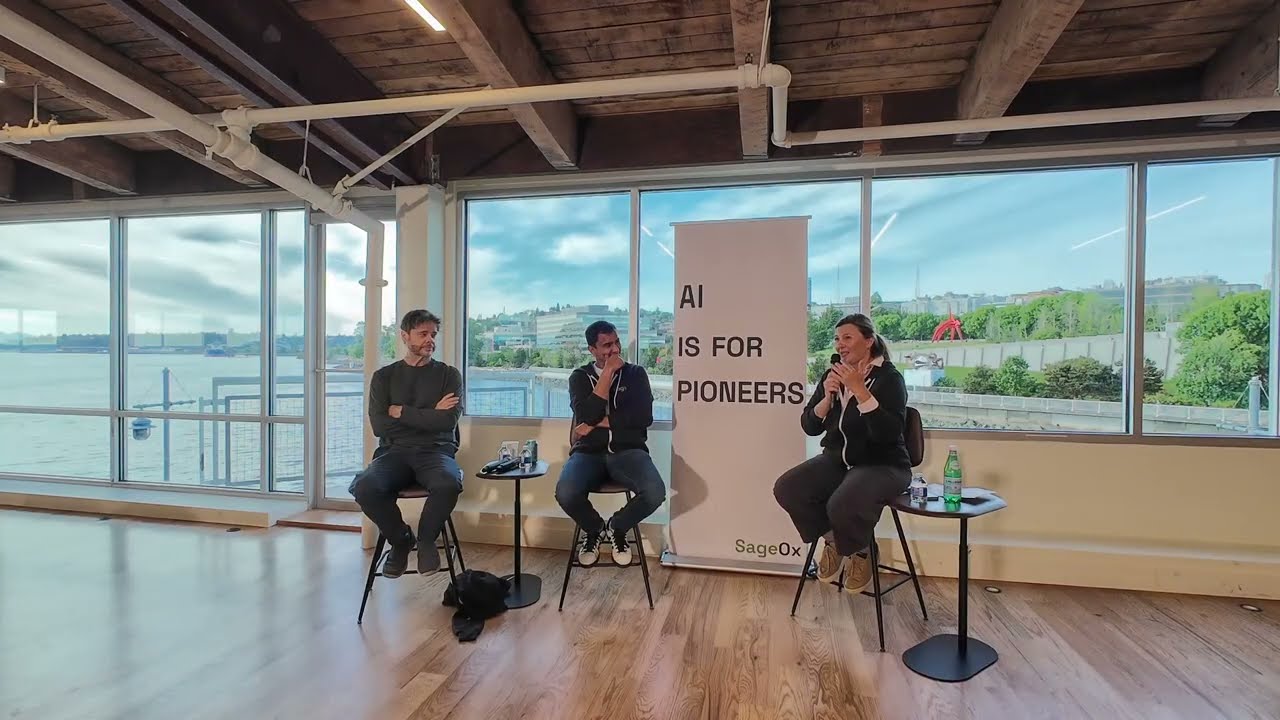
This short conversation, recorded in SageOx's offices, is about that integration, the Seattle AI community that made it possible, and why face-to-face collaboration is more important now, not less.
A specific kudos to the people who built that room: AI Tinkerers — and Joe in particular — and Tensorwave, who hosted Building the New AI Tool Stack, the VIP dinner for engineering leaders where Ajit and Zhenbin first sat down. None of what follows happens without that table.
Transcript
Ajit: Thank you, Jonathan, for taking this recording, and I want to welcome Zhenbin to the AI2 incubator space. I want to give a little bit of the story about what we're talking about today.
On May 7th, I was invited to an AI community dinner — this is something Seattle has — that allowed us to sit at a table together. Zhenbin and I didn't know each other before that dinner. He was sitting quite far away from me, and when he came over to talk about what he was working on, he mentioned this new API and new service on Zoom that was very intriguing to me. What it did was top the Hugging Face leaderboards on ASR. Once I heard about it, I didn't even have to talk to him — I came back to the office, and on top of that I learned about a new protocol, WebTransport, that was supported by Safari as of March 2026, and a protocol called Media-over-QUIC (MoQ), which Zoom is working on along with Meta, Cisco, Akamai, and others in the open-source community.
I was able to fit it all together to have a team-standup experience that's very different from what was possible even a month ago. What I want to highlight is two or three things. One is just how much innovation is happening in the industry — nothing to do with us. This isn't Zoom, this isn't Meta, this isn't AI. The second is that because all of these technologies are happening, face-to-face engagements — dinners and actual meetings — are actually becoming more important. So I'm going to pass the baton over to Zhenbin to talk about his side of seeing what he did, and what we're also going to see in the near future.
Zhenbin: Yeah, thank you, Ajit, for inviting me over — I tagged along to see all the interesting work you're working on. I'm actually super, super impressed. When you reached out to me, we'd had that dinner, and we'd just released the API. We were proposing it to a few people to see who was interested, but most people hadn't had a chance to adopt it yet. And then a few days later, you reach out and say, "hey, I've already started using the API" — I was super impressed, because you were essentially among the earliest adopters of this API.
The speed you guys are moving at is incredible. What's even more impressive is that you didn't even reach out to ask me, "hey, how do you call this API? How do you get this issue resolved?" — whatever the problem was. You just got it done. I think that's super super impressive.
Ajit: I love the service you built — that's why I was jumping up and down when I heard about it. The part I do want to talk about is that people think about startups as being about money, or just the excitement of new things. But I want to talk about how innovation actually happens. You put up a service, you may not have anticipated what I'm going to do with it — but I can just go and use it. It's Lego blocks. You're giving me a Lego block, and I'm going to do what I want to do with it. Then I show it to you, and maybe you'll have a different idea after you see what I'm doing.
That ping-pong has to happen between our heads to see what we're doing. And I think that can only happen in places like Seattle, when we get to spend time in front of each other and talk to each other.
Zhenbin: Yes, yes, yes. I think there are two things. One: we're in the AI era — and since ChatGPT was released two or three years ago, the entire industry has been excited. Many things are getting better and better. So the industry has been moving — working together, doing all this AI innovation. Zoom is part of that process, doing the transformation. That's one.
The other is being in Seattle — we have this vibrant AI community. You've been in the industry for a long time, and now you're jumping back in, and your company is doing something very innovative.
Ajit: What we're trying to do, for reference, is just that we want teams and AI coworkers to collaborate as if humans and agents are the same thing. We're working toward that. But one of the most interesting things is that we believe product development is a team sport, and it's going to continue to be a team sport — it's going to involve teams working together and communities working together. You know — you're not part of our team, but you're part of the Seattle community. That's the one thing I want to highlight and take away: it'll continue to always be humans bouncing ideas off each other, alongside AI. I don't think all the narrative about AI replacing humans and human ingenuity is going to happen. It's always going to be humans trying out things with each other, and I don't see that changing ever.
Zhenbin: I totally agree. Humans are still making all the critical decisions moving forward — but we now have the AI as a powerful assistant, as a teammate, actually, in the product you're building. You're treating the AI as one of the organization. I think that's super exciting — it aligns well with some things we're building at Zoom. Different in execution, but conceptually we're all embracing this new world where AI is a component of the organization. We're super excited to see how you guys come up with these creative products.
Ajit: Let's wrap up this conversation here. One more shout-out to Jonathan, who's part of this ecosystem — you can look over into the video and say hi if you like. Thank you for this. We'll continue now with a little bit more conversation around the technical side.
Zhenbin: Yeah, I hope so.
More on the Zoom AI services: developers.zoom.us/docs/ai-services. Drop us a note if you'd like a specific topic covered: feedback@sageox.ai.