
Oxy goes to art school
What we learned from sharing our last two Friday-morning standups

Over our last two standups we brought a few people from outside the company in to watch how we work — Gas City's Chris Sells and Julian Knutsen on 29 May, and Jessica Hagy with Apurva Luty on 5 June. Both are up on YouTube.
The surgeon Wilfred Trotter wrote the line a hundred years ago:
A new idea is the most quickly acting antigen known to science. If we watch ourselves honestly, we shall often find that we have begun to argue against a new idea even before it has been completely stated.
"Before it has been completely stated." That is the real bottleneck on innovation — not having ideas, but getting the half-formed ones out of one head and into another before the immune response fires.
Why the reflex is so hard to beat
It isn't a bad habit. It's perception itself. We don't see reality; we see our model of it.
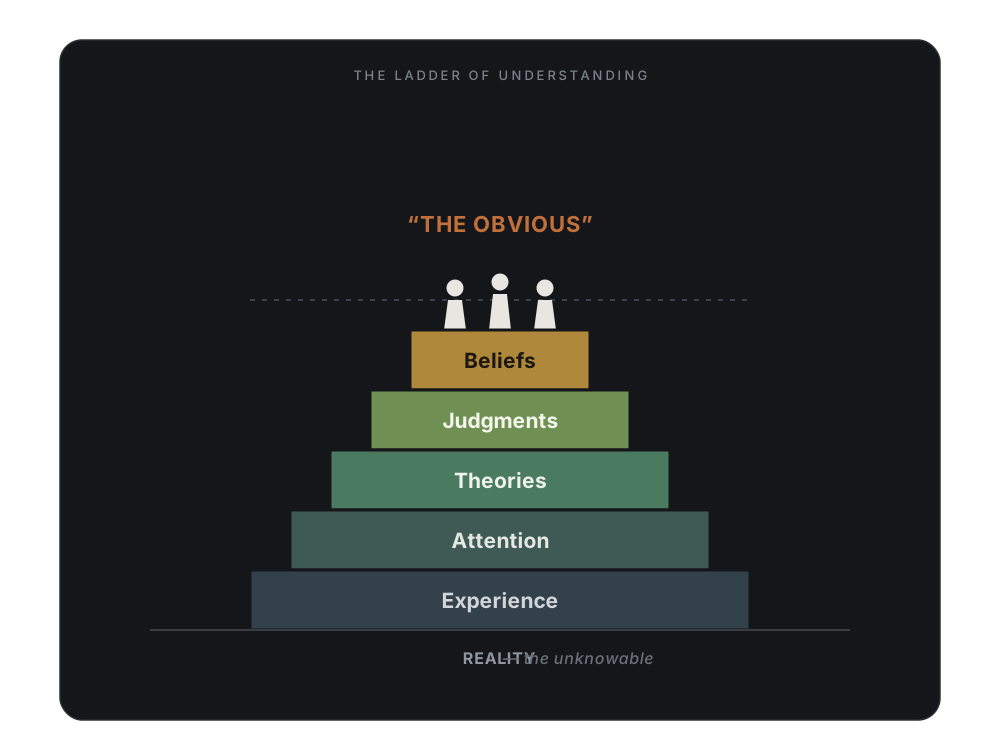 The ladder of understanding, after Dave Gray's Liminal Thinking.
Liminal Thinking draws it as a ladder: unknowable reality at the bottom; a thin slice of it we get through experience; the sliver of that we attend to; the theories we build on the sliver, the judgments on the theories, the beliefs on the judgments — and, at the top, the thing we call the obvious. Goethe put it in four words: we only see what we know.
So a genuinely new idea fails our first, automatic test — is it internally coherent; does it fit what I already believe? — and never reaches the test that matters — is it externally valid; does it actually work? It gets rejected on contact and filed under mistake. Polanyi's "we know more than we can say" is the same point from the other side: the most valuable idea in a head is the one that hasn't yet found words — and the one without words is the one no one else can see.
You can't will this reflex off. But humans have built rituals that suppress it on purpose. Four are worth copying.
Ritual 1 — Pin it to the wall
Start with the most literal cure, the one art schools built. They call it the crit. You pin the rough draft to the wall — not the polished thing, but the unresolved, internally-incoherent thing — and the room responds to it out loud while it's still wet. The whole pedagogy is a structural override of the antigen response: the rule of the pin-up is that you react to what is on the wall, not to whether it fits your ladder. Architecture schools call it a jury; designers do desk crits; the move never changes — get the strange idea out of the single head and onto a surface a second set of eyes can stand in front of, early, when it is most fragile and most valuable. Engineers are almost never taught this. Painters train it for years.
Ritual 2 — Bet on the founder, not the idea
Paul Graham, in Crazy New Ideas: "If someone I knew to be both a domain expert and a reasonable person proposed an idea that sounded preposterous, I'd be very reluctant to say 'That will never work.' … They know how implausible it sounds. And yet they're proposing it anyway. That suggests they know something you don't."
We are living in William Gibson's present: the future is already here, just unevenly distributed. So when you hear something that doesn't make sense to you — a glitch in the matrix — pay it extra-special attention. The thing that fails your coherence test is often the thing most worth pinning to the wall.
Graham's is a rule for deliberately overriding your own perception. YC turned it into Demo Day — a ritual that should run forever. Twice a year, founders get a minute and a slide to pitch a future the room can't yet see. Nobody can evaluate ideas that early, so investors read conviction instead of legibility. They fund the part they don't understand. The illegible part is the bet — antigen suppression, institutionalized.
Ritual 3 — Keep the door open
Richard Hamming, in You and Your Research, gave two rules worth living by. "If you do not work on an important problem, it's unlikely you'll do important work" — go at the hardest thing. And: "He who works with the door open gets all kinds of interruptions, but he also occasionally gets clues as to what the world is and what might be important." Hamming ate lunch at the physics table while he was a mathematician, on purpose. The interruptions were the research. The closed door keeps strange proteins out — and keeps you from ever seeing what matters.
Ritual 4 — Yes, and
The oldest version is jazz. You can't improvise on nothing, said Mingus — you've gotta improvise on something. The something is whatever half-formed thing someone was brave enough to say out loud. The move is to take it and go +100, not to prove your own brain is bigger. Engineers are rarely taught this; improv troupes and jazz quartets train it for years.
This is why the lone genius is mostly a myth. You can't proofread your own blind spot. A strange idea only survives if it jumps to a second head — one with a different ladder — before the antigen response in the first head kills it.
The outside eyes
Each of our four guests was there to see what we can't.
Jessica is rituals one and three made flesh. She pointed out that graphic facilitators create meaning but also work like a spy in the room — the staff psychologist from Billions who just listens and notices. She told us SageOx was doing the same thing she does: taking four hours of conversation and distilling it into a page, just like her art. "When I was reading about, sort of Google-stalking what you guys were doing," she said — and then named a pattern we were far too inside to see. That is the cure for we only see what we know: borrow a pair of eyes that knows different things.
Apurva named the substrate underneath all four rituals. "This hive mind you're describing is actually the function of what we call real-time presence," she said, from her years at Discord watching communities form and collapse on whether the group had enough live presence to survive. She put numbers on it: past 50 participants, the only communities that stayed healthy were the ones with active moderation.
Milkana reacted to that — in the agentic era, those thresholds may shrink by an order of magnitude. The old constants — 150, 50 — are turning into variables.
The three eras of working in the open
Julian put the longer arc in focus. Software used to be written behind closed office doors: in the waterfall era an engineer spoke mostly to a manager, and the work stayed invisible until it shipped. Agile cracked the door — the daily standup let the team into the work-in-progress, but only once a day, and only in summary. Recording everything is the next turn of that ratchet: colleagues, and now AI coworkers, see the thinking as it becomes code, shared closer to the speed of thought than the speed of the daily update. Each era widened the aperture on unfinished work. We are pushing it as far as it will go.
The ritual we're building
Record everything. Work in the open. Make the team's collective memory queryable by humans and agents.
That is our always-on crit — a pin-up wall that never comes down. The rough draft goes up the moment it exists, so a half-formed idea gets a second head, a third, and now a synthetic fourth before the antigen response in the first head can kill it. The strange protein gets courted instead of rejected — and our AI coworkers are in the room for it too.
We are in a real cognitive disruption. The constants are moving, and the edge belongs to whoever recombines fastest — a contact sport, because you can only recombine what you can perceive, and you can only perceive past your own ladder by standing next to someone with a different one.
Seattle right now is dense with people who will tell you the thing they can't fully explain yet — over champagne in White Center, at an AI dinner, in our office on a Friday morning. The cluster best at courting the antigen — together, with the door open and the work on the wall — is the one that runs away with this era. Everything else is downstream.
Like YC, we're thinking hard in 2026 about how a company optimizes itself — the apparatus that lets a team compound its own learning. We'd love to meet others working the same problem: to show what we're building, share what we've learned, and trade the half-formed ideas none of us can fully explain yet. If that's you, come say the strange thing out loud with us.
Postscript — Apurva on Dunbar, communities, and the shared layer
After the standup, Apurva sent over the research underneath her real-time-presence point — the clearest case we've seen for why shared context serves humans and agents at once. We're keeping it here close to her own words.
Dunbar's number came from studying primates bonding through grooming — real-time, one-to-one. Humans reach ~150 instead of ~50 only because language let us "groom" several people at once through conversation — but it's still synchronous. Holding a 150-person group together takes roughly 42% of waking time spent on social bonding. The one thing that scales bonding past small-group size is behavioral synchrony — singing, moving, being present together in real time (at Discord, gaming) — which Dunbar found doubles the endorphin hit "for no extra effort."
Which is exactly why it breaks online. Async, many-to-many text is a weak substitute for synchronous presence; Dunbar's own studies found social-media use doesn't grow your network or produce closer relationships. So the most active Discord communities being under 50 isn't a quirk — it's the size at which everyone can actually share real-time presence. Past that you don't have one community; you have a banner over many smaller real-time clusters. (Christopher Allen's analysis puts the active sweet spot at 45–50, with forums historically fragmenting around 80.)
This is why shared context — for humans and agents — is better for everyone: it attacks that time budget from both ends. You had to "be in the room" because the decisions and reasoning lived only in people's heads in the moment; miss it and it was gone. Capturing that context makes the output of presence durable — a teammate who wasn't there absorbs it later without anyone re-narrating, so each unit of synchronous time compounds instead of evaporating. And agents change the math in a way humans alone can't: a person's context budget is capped by that 42% ceiling; an agent's isn't. It holds and recalls far more shared context than any human and doesn't decay between sessions — so it carries the recall-and-retrieval load that used to eat the budget, and hands humans back their scarce synchronous time for the judgment and bonding that only presence provides. Same shared layer, serving both: humans get their presence budget back; agents extend the group's effective context past the Dunbar ceiling.
So agents in isolation probably lower the ceiling — each siloed agent quietly replaces a human interaction. Shared context flips it. An agent that carries what the team knows, not just what one person told it, becomes a conduit to your colleagues instead of a substitute for them — and that's how you raise the ceiling instead of lowering it.