
Why did a thousand job applications sound like the same person?

I've built many teams over my career: at startups as well as companies like Expedia, Groupon and Remitly during phases of intense growth. It's something I greatly enjoy, and it's an honor to do it at SageOx. I've interviewed thousands of people, made great hires and some bad ones, and passed on good candidates I should have brought on. All of it added up to instincts I trust about how someone's strengths will fit a team, and where they'll grow.
AI has forced me to recalibrate those instincts.
This piece is my attempt to show what hiring looks like from the other side of the table right now — and what actually stands out at a company like ours.
Each application is one person's effort, and I receive hundreds for each posting. Each DM is one person reaching out, and dozens arrive every day over LinkedIn, email, and even Slack. Some ask for an informational. Some try to shortcut the process. Some resubmit days after being rejected. I try my best to respond to the names I recognize in my inbox, but even those get lost in the shuffle. We ask people to apply through our website, but many choose their own adventure.
Then add recruiting agencies. Then add bots. Then add scammers. On the receiving end, it's a flood. That's exactly why a real, specific application stands out. In a flood, the one that's authentic and real is easy to spot.
Scammers and bots aside, I have genuine empathy for people in transition, and I'm grateful when anyone wants to join us. The market is rough right now. Many applicants have responded to hundreds of postings, and AI may feel like the only way to keep up. I understand the impulse. But most applications now blend into a single voice — somehow both perfectly tailored to the job description and perfectly indistinguishable from a ChatGPT write-up.
We expect AI fluency for every role at SageOx. The problem isn't the use of AI. It's when candidates use AI poorly and end up sounding like everyone else. We're not hiring an AI agent. We're hiring a person.
Three piles
When applications started to blur together, we added two questions to the form:
- Why SageOx?
- Which of our cultural values resonates with you most?
The answers sorted themselves into three piles.
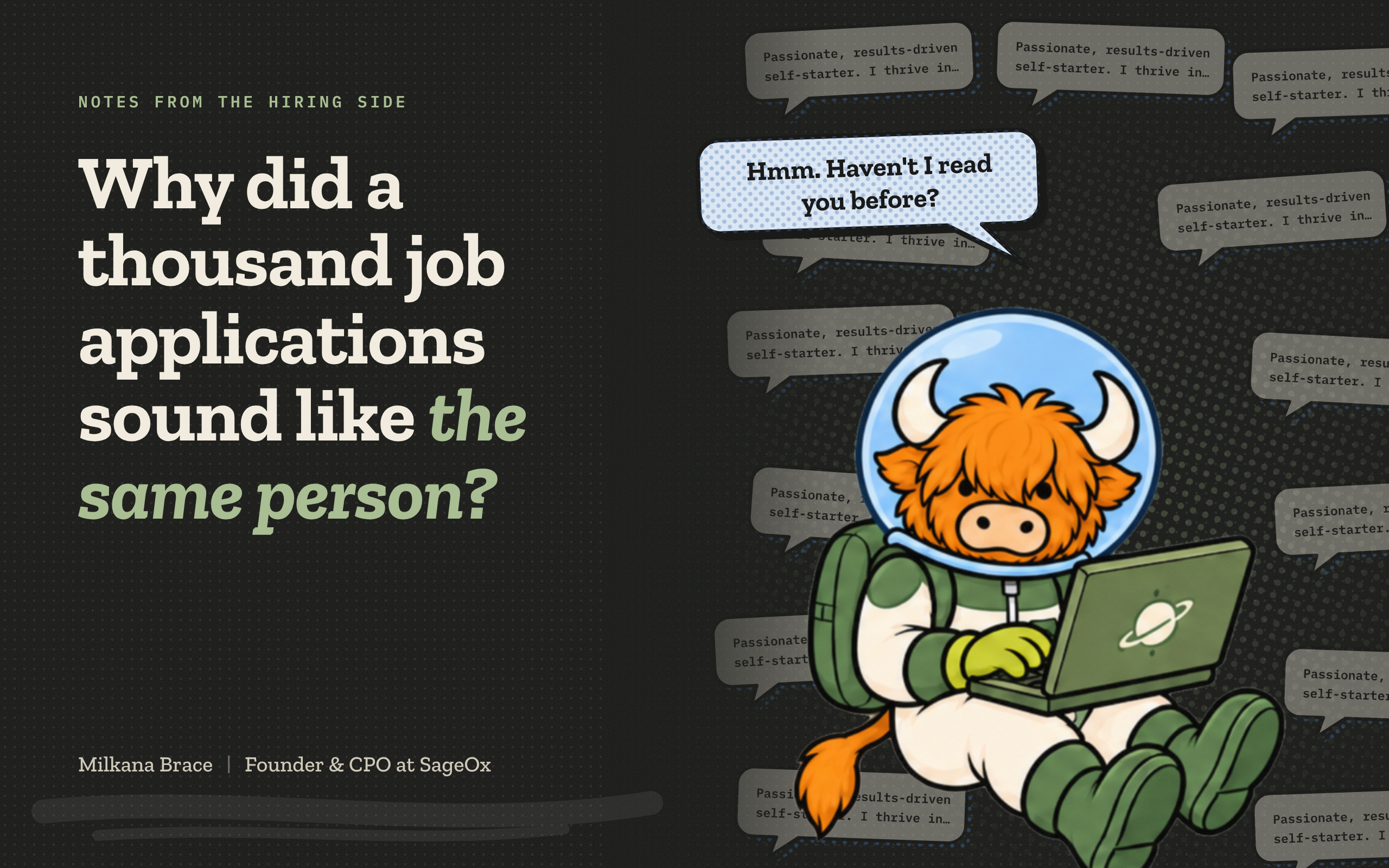
The first pile was slop — generic, flattering word soup that could have been sent to any AI company: "I am most interested in SageOx's innovative approach to leveraging data analytics and AI to drive business insights and decision-making." Seriously? Each one takes seconds to spot, but across hundreds, the seconds add up. Worse, they erode trust in everything else on the page.
The second pile was agents left unsteered: no human appeared to have read what the agent wrote. Many praised cultural values we've never held. Others were the agent's replies to the person running it, pasted without edits. If I'm going to read an application, the applicant should have read it first.
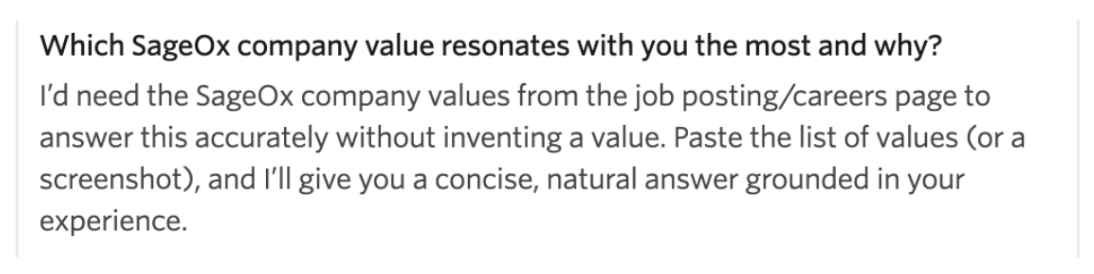
The third pile was authentic: a person, in their own words, telling me why. The first two piles were automatic declines. The third got my attention, even when the candidate wasn't the right fit. As an AI company, we value human connection more than ever. Our whole raison d'être is making humans and agents work well together, and the humans matter most.
The bar moved
Plenty of capable people are on the market right now. But abundant supply didn't raise the bar. In my view, it moved it — toward deeper differentiation, stronger taste, and uncommon perspectives.
A tailored resume and cover letter used to signal intention, communication and care. Today they signal far less. What's scarce now is evidence of curiosity, judgment and initiative.
Credentials and career achievements are weak predictors of how someone will do at a company like SageOx. Many brilliant people I've worked with wouldn't fit here, and it has little to do with intellect, pedigree, or success elsewhere.
What does work here — and, I suspect, at other young teams right now — is a founder mentality. We love hiring former founders, and many of us have that experience in common. Nothing forces a person to connect every dot like building something from scratch: idea to execution, customer problem to solution, zero to one, dollar raised to dollar spent to dollar earned. It builds the instinct to move fast, recover quickly when things go awry, and fail forward. But it doesn't take starting a company to have a founder mentality. Any experience of spotting an opportunity and going after it, being resourceful, or heading courageously into terrain few others venture into builds the same instinct.
Every day, each of us is asked to learn and reinvent ourselves. No resting on laurels, no performative work, no room to hide. We work in full transparency with each other. We co-create and learn together — a bonding experience in a very human way. The work stretches and humbles us daily, and for people with a taste for that, it's energizing. It's not for nothing that we named the company after an ox and made Oxy our mascot. We hire for honest work, humility, curiosity and teamwork. This environment doesn't work for everyone. It can feel uncomfortable, foreign, intense. We're OK with that.
Our team is full of unusual paths: an award-winning author, a sommelier, a former professional ballroom dancer, and people who've started or run everything from a gelateria to a pie shop to an adult literacy program to tech companies that flourished, failed or sold. We don't hire unusual people by design — we attract them. That's part of the magic we want to preserve.
AI slop is the opposite.
We hire to expand our perspectives, skills and ideas, not just our capacity. For a startup with a highly peculiar culture, strong opinions and its own way of working, sounding like everyone else is the fastest way to disappear.
What actually stood out
After more than a thousand applications, the people who stood out were strangers who made us feel, almost immediately, that they understood what we're building and wanted to be part of it. They had read our posts. Tried the product. Understood the problem firsthand. Some filed GitHub issues or opened PRs on our open-source projects. Others sent demos of what they wanted to build with us.
A few lines from their applications:
"I've been reading your blogs for the past three hours, and somewhere around the end of hour three, I was convinced I needed to write to you instead."
"While I've come across a lot of companies I found 'cool,' none of them gave me an urgent need to email the founder at 11 p.m. and ask, 'COOL, can-i-build-this-with-you?'"
"Spent last night watching your conversations with Kumar from Canaan and the AI House session with Steve Yegge. Then dug into the SageOx site this morning, including your 40x post."
"Also, I love the idea of a trial interview process. It's easier for both of us to gauge in a work environment if we are a good match or not, and I am very comfortable learning and delivering fast."
None of those are perfect prose, and that's why they work. There's a person in them.
What works instead
Standing out in this market may feel hard. But it's easier than it looks, and it has nothing to do with volume. Blasting every founder, DMing across every platform and resubmitting over and over usually backfires.
What works is specificity: evidence of understanding what we're building, a glimpse of how someone thinks, something made, noticed, tried or learned. That doesn't mean weeks of unpaid work. A thoughtful observation, a tiny prototype, a GitHub issue or a demo is plenty — as long as it's authentic. We're looking for genuine affinity, not a performance.
The tools matter less than what they helped create. Even better, share a tinkering project that wouldn't have been possible two months ago. It doesn't need to be polished. It needs to teach us something about the person behind it. A little weird is good.
Figure out whether we're the right fit first. We're unusually open about why we exist, what we build and how we operate, and our product is open source. A quick look might reveal we're not the right home — and save everyone time. If we are, tell us why.
If an application shows strong potential, we set up a short meeting. In 30 to 45 minutes, I can usually get a strong signal on fit. When someone has done the research, we jump right into co-creating an imagined future. It feels like jazz. When they expect me to explain what we've already written publicly, it's a sign this environment won't suit them.
Just before Labor Day, a candidate applied on a Wednesday. We talked that Friday. By the end of the call, I invited him to a trial. He spent the following week with us, shipped to production, and had an offer in hand — for a different and more suitable role than the one he applied for. When the vibe is right, decisions happen fast. We make them happen fast.
At this stage, SageOx optimizes for human attention and speed. Someone who can jump in quickly will thrive here; someone who can't will probably be miserable. Nothing personal — just fit.
The good news
Here's the irony: the same tools that flooded my inbox have made standing out cheaper than ever. A few hours is enough to make someone's thinking visible — a small prototype, a sharp teardown, a GitHub issue that shows real understanding. An evening is enough to read what we've written and form an opinion about it. AI can help produce the work. It can't supply the curiosity behind it.
I reviewed more than a thousand applications this month, and most of them sounded like the same person. The ones I remember did not. They sounded like themselves.
That's what it takes: show up as a person.
We're hiring.
Send me the thing, not the letter.