
Human Attention Is the Scarce Resource: Why we added a fifth company value

How does company culture get shaped?
When Ajit, Ryan, and I first talked about starting something together, even as the outlines of the actual product were still coming into focus, we agreed on the kind of company we wanted to build. Not what it would do, but what it would be. How ambitious? How innovative? How large? With what defining characteristics?
That exercise was essential. It ensured the three of us were signing up for the same adventure, and it gave us a yardstick for evaluating everyone who would join later: would they fit the crew we meant to build?
Those early conversations gave us our company name, our mascot Oxy (who has since had a much-needed glow-up thanks to Emory!), and four cultural values that have been durable and defining of our journey so far:
01 — We break trail. There is no map. We're drawing it, and momentum matters more than certainty.
02 — We build for every terrain. Flexible enough to adapt, solid enough to rely on. The ground changes, the principles hold.
03 — We take pride in our work. From infrastructure to interface, we craft products we're proud to stand behind.
04 — We work in the open. Our thinking, decisions, and intent are communal ground for teammates and agents alike.
Since our start in January 2026, the industry has changed significantly, and so has our own company, but with every turn we have only leaned harder on these four. They have proven formative, and so far they have held.
Cultural values serve two purposes at once. First, they reflect who we are: how we operate, how we show up, and how we engage in everyday interactions. Second, they are aspirational — a north star for the things we want to keep doing, and do better.
For cultural values to be meaningful, they cannot be all-encompassing. These four are not the only things we value, of course. Integrity, customer focus, speed: those are table stakes. Some version of them appears on nearly every company's website, and they all end up sounding the same. We wanted to focus on what makes our culture distinct.
Change is constant
At SageOx, we routinely revisit how we operate. While our mission has been steady, nearly everything else has changed, multiple times over: the tools, the processes, our codebase, what we spend our days on, who is on the team, even where we sit. In the past nine months, we have worked out of nine different spaces, unless I've lost track. It is constant change.
Some of that change is organic, some triggered by outside developments, and much of it self-inflicted. Staying at the forefront of a fast-moving industry means throwing away prior work, assumptions, and wins when they stop serving us. What was great last month may be stale today. Nothing is sacred.
At some point we had to revisit our values too. It was not a formal process. We realized that an idea central to how we work had never been written down, and we were explaining it over and over to every new hire. Part of the failure was mine: I had been asking people to change how they show up, what they talk about, and how they engage the team, without ever naming the value behind the ask. That was the signal to write it down.
It has to do with attention, both personal and collective.
Naming the fifth
So this week we gave the idea we kept repeating to new hires a name. It earned its place as our fifth value, alongside the original four:
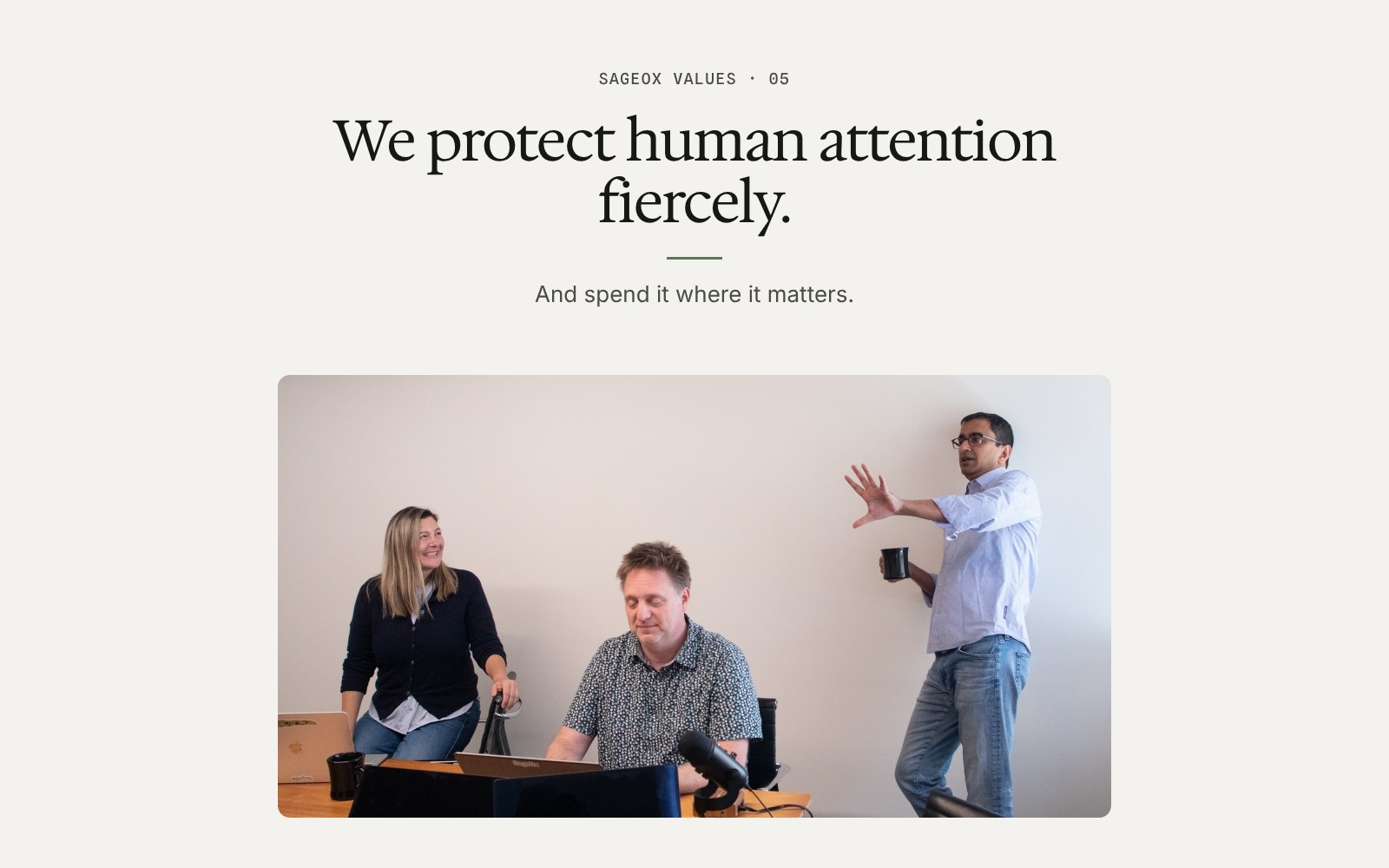
05 — We protect human attention fiercely and spend it where it matters. We embrace rituals, norms, and tools that make status updates obsolete. So when we ask for each other's attention, it's for shared learning, creative problem-solving, bigger ambitions, or the joy of co-creating.
As new people have joined, they have naturally been eager to pursue the many opportunities ahead of us, and to share with the team, enthusiastically, what they have been working on. In most other environments, those updates on progress would be welcome. But we do things a bit differently here. Meetings are not about keeping each other updated on how much work we have done. They are about using our time together to learn, grow, and celebrate as a team.
None of this is an argument against meetings, or against collaboration. It is about reserving synchronous human attention for the things that benefit disproportionately from people being present together: working through a hard problem, making a call that needs several minds, learning from each other, celebrating a win. Everything else can happen asynchronously, and usually happens better that way.
We have a ritual for our morning updates that is meant to capture that intent. Merge Wall, our fifteen-minute morning gathering, is explicitly not a round-robin status report. Each of us shares only what is new and material for the group — a change in direction, a risk, a lesson, a win — or passes, which is expected and encouraged. Even so, I found myself re-posting the meeting guidelines, flagging individual digressions, and nudging group Slack threads that only needed two people toward DMs. At one point I posted this:
Any 5 minutes of team time are worth an hour of collective human time and more than a day of agent-driven work.
The question is not whether the work matters. It is whether everyone else's attention would materially improve the outcome or alter their own work. Before taking the floor, ask: will knowing this change what someone else understands, prioritizes, decides, or does? A five-minute update about important, material work that would not change anyone else's approach or deliverables is not worth the hour of collective attention it costs.
This way of staying connected only works because nothing is lost. The work is already captured in SageOx, where it is remembered and surfaced when and where it matters; we could not operate this way without it. Staying silent doesn't imply someone did nothing significant. It implies they have it covered: their work is contained, others trust them, and no one else needs to get involved. We divide and conquer.
This can look like it is in tension with our fourth value, working in the open. It is not, and the distinction matters. We want context to be broadly available without requiring everyone to consume it synchronously. Information is accessible by default; attention is not consumed by default.
Make information abundant. Treat attention as scarce. Let agents bridge the two.
Trust, not updates
Underneath this value is trust. Everyone on this team is here because we trust them to do great work, and no one needs to justify that work to the rest of the team. There's no need to demonstrate busyness.
So how does company culture get shaped? Less in offsites and values posters than in small moments, in the micro-interactions: the update someone chooses to skip, the thread that moves to a DM, the meeting that ends early because nothing left needed all of us.
The first four values described the company we set out to build. The newest value captures something we learned by building it — and gives every person who joins us permission to protect their attention, and everyone else's, too.